How to Choose a Bamboo Wet Wipes Manufacturer?

Choosing a bamboo wet wipes manufacturer involves more than comparing prices or selecting a fabric labeled as sustainable. For brands, retailers, and distributors, the right manufacturing partner must be able to match material performance, liquid formulation, packaging requirements, quality control, and production capacity to the intended product.
Bamboo wet wipes can be developed for baby care, personal hygiene, facial cleansing, and other applications, but the specifications required for each product may differ significantly. Before requesting an OEM quotation, buyers should understand how the substrate, formulation, and packaging work together in the finished wipe.
1. Check the Actual Bamboo Fiber Composition
The first step is to confirm what the manufacturer means by bamboo fiber.
Bamboo-derived fibers are not all processed in the same way, and the term “bamboo wipes” alone does not establish the exact composition of the finished substrate. Buyers should request the material specification and clarify whether the wipe uses bamboo-derived viscose, another bamboo-based fiber, or a blend with other fibers.
This distinction matters because fiber composition influences softness, absorbency, tensile strength, and the product’s environmental claims.
For brands positioning their products around sustainability, ask the manufacturer for supporting material documentation rather than relying solely on descriptions such as natural, green, or eco-friendly.
Biodegradability also depends on the complete product construction and the conditions under which it is tested. A bamboo-derived substrate does not automatically make the entire wet wipe, including its lotion and packaging, biodegradable or compostable.
For a broader comparison of plant-based substrates and product formats, see our guide to biodegradable wet wipes.
2. Match the Wipe Material to Its Intended Use
A suitable bamboo substrate should meet the practical requirements of the finished product.
For baby and personal care wipes, buyers may prioritize a soft texture, sufficient absorbency, and compatibility with the selected lotion. Household or general cleaning wipes may require a different balance of wet strength, durability, and liquid retention.
When evaluating samples, check whether the wipe remains intact when saturated, releases moisture consistently, and feels appropriate for its intended use. Sheet size, basis weight (GSM), texture, and folding format should also be considered.
Rather than choosing the softest or thickest fabric automatically, define the performance requirements first and compare samples against those requirements.
3. Evaluate Formula and Skin Compatibility
The substrate is only one part of a wet wipe. The liquid formulation also affects cleansing performance, moisture retention, product stability, and the user experience.
Depending on the application, manufacturers may offer fragrance-free, moisturizing, or other customized formulations. Ingredients such as aloe vera or vitamin E may also be considered when appropriate for the product concept and formulation requirements.
Ask how the manufacturer evaluates formula compatibility with the substrate and packaging. For products intended for sensitive skin, request relevant safety assessments and supporting test documentation.
Claims such as hypoallergenic, antibacterial, or suitable for newborns should not be used without appropriate evidence. Buyers should also confirm that the final formula meets the regulatory requirements of the intended market.
A reliable development process considers the fabric and lotion together rather than treating them as separate purchasing decisions.
4. Review Packaging and Private Label Options
Packaging affects product presentation, convenience, moisture retention, shipping, and retail suitability.
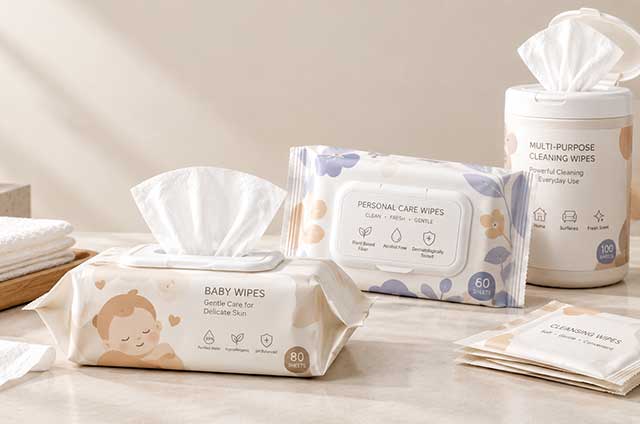
Depending on the product and target market, bamboo wet wipes may be developed in resealable soft packs, refill packs, tubs, or individual sachets. The appropriate format depends on the number of wipes per pack, intended usage, distribution channel, and brand positioning.
Before production, confirm the following details:
Sheet count, wipe dimensions, and fabric specifications.
Packaging format, opening and resealing method, and artwork requirements.
Formula, fragrance preferences, and ingredient declarations.
Label information and market-specific compliance requirements.
Packaging compatibility with the finished wipe.
For brands developing a complete product line, review our wet wipes materials and packaging options to understand the available customization choices.
A manufacturer should also clarify which packaging components can be customized, whether printed packaging requires a minimum order, and how artwork approval is handled before mass production.
5. Verify Quality Control and Documentation
A manufacturer’s product claims should be supported by relevant specifications and quality records.
During supplier evaluation, ask about incoming material inspection, lotion preparation, production hygiene, sealing integrity, microbiological controls, and finished-product inspection. The exact checks should reflect the product category and its intended use.
Useful documents may include material specifications, ingredient declarations, product safety assessments, stability data, and applicable test reports. Depending on the market and product type, additional documentation may be necessary.
Do not assume that a factory registration or management-system certification automatically proves every environmental, safety, or performance claim made for an individual product. Confirm which facility, material, or finished product each document covers.
A supplier that can explain its quality procedures clearly makes it easier for buyers to assess manufacturing risks before committing to a large order.
6. Compare OEM Capabilities, MOQ, and Lead Time
A suitable bamboo wet wipes manufacturer should be able to explain how a project moves from initial specifications to approved samples and commercial production.
Before comparing quotations, provide the same requirements to each supplier. These should include the target application, substrate composition, wipe dimensions, GSM, sheet count, lotion requirements, packaging format, estimated order volume, and destination market.
When reviewing an offer, clarify:
Minimum order quantity for the selected product and packaging.
Whether the quotation includes customized lotion and printed packaging.
Sample preparation, evaluation, and approval arrangements.
Production lead time after specifications and artwork are approved.
Inspection procedures, export documentation, and shipping terms.
The lowest unit price is not necessarily the lowest overall cost. Material changes, packaging setup, testing requirements, and inconsistent production can all affect the final commercial result.
For brands requiring customized formulas or product specifications, wet wipes product development provides further information about the development process.
7. Work with a Manufacturer That Supports Long-Term Supply
For an established brand, the first order is only one part of the supplier relationship. Consistent specifications, repeatable production, clear communication, and reliable order planning become increasingly important as sales grow.
Before placing a commercial order, confirm how the manufacturer records approved specifications, manages changes, handles quality issues, and maintains consistency between production batches.
It is also useful to establish how demand forecasts, packaging updates, and future product variations will be communicated. These details can help reduce avoidable delays when expanding into new sales channels or markets.
SYWIPE supports OEM and private label wet wipes projects involving material selection, formula development, packaging customization, sampling, and production. The appropriate specifications and commercial arrangements depend on the product requirements and order scope.
Brands planning to launch their own product line can review our private label wet wipes services for further information.
Frequently Asked Questions
Are bamboo wet wipes biodegradable?
Bamboo-derived fibers may offer biodegradable properties, but the result depends on the actual fiber composition, other materials in the wipe, formulation, and applicable test conditions. Buyers should request evidence supporting any biodegradability or compostability claim made for the finished product.
Can bamboo wet wipes be customized for private label brands?
Yes. Depending on manufacturing capabilities and order requirements, customization may include sheet size, substrate specifications, lotion formulation, sheet count, packaging format, and branded artwork. Confirm the available options and minimum order quantities before requesting a quotation.
What should buyers check before ordering bamboo wet wipes samples?
Confirm the fiber composition, GSM, sheet dimensions, lotion requirements, intended application, and packaging format. Evaluate the samples for softness, wet strength, absorbency, moisture distribution, and suitability for the target market.
What affects the MOQ for custom bamboo wet wipes?
MOQ depends on factors such as fabric specifications, sheet count, formula requirements, packaging format, printing setup, and production arrangements. Ask for a quotation based on a clearly defined specification so different suppliers can be compared fairly.
How can brands verify a bamboo wet wipes manufacturer’s quality?
Request relevant material specifications, product documentation, applicable test reports, and information about production quality controls. Confirm that certificates and test results are relevant to the facility, material, or finished product being offered.
Develop Your Custom Bamboo Wet Wipes
The right bamboo wet wipes manufacturer should help you balance product performance, material requirements, packaging, quality control, and commercial objectives.
SYWIPE works with brands, retailers, and distributors on customized wet wipes projects, from material selection and formulation to packaging approval and mass production.
Share your target application, preferred substrate, packaging format, and estimated order quantity to discuss a suitable manufacturing solution.