Kitchen Paper Towels: Materials and Performance
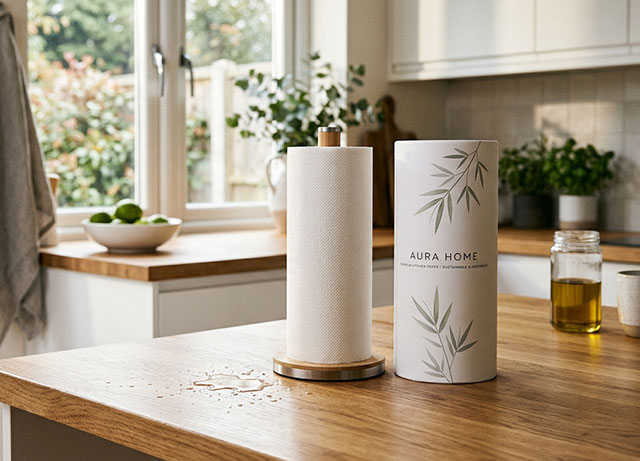
Kitchen paper towels are designed to absorb liquids, handle everyday spills, and make routine kitchen tasks easier. However, not all paper towels perform the same way. Their absorbency, wet strength, thickness, and texture depend on the fibers used and how the paper is manufactured.
Understanding kitchen paper towel materials helps consumers choose suitable products for household use, while commercial buyers can evaluate paper products according to their cleaning requirements, consumption levels, and budget.
This guide explains the materials used in kitchen paper towels, how they are made, what affects their performance, and how to manage used paper products responsibly.
What Are Kitchen Paper Towels Made Of?
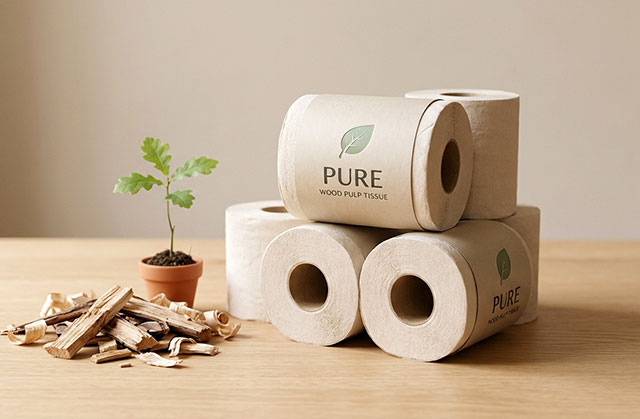
Most conventional kitchen paper towels are made primarily from cellulose fibers. These fibers commonly come from wood pulp, although some products use recycled fibers or alternative plant-based materials.
The fiber source influences the paper’s texture, strength, absorbency, and environmental characteristics. However, the final performance also depends on the manufacturing process and product design.
Virgin Wood Pulp
Virgin wood pulp is produced from wood that has not previously been processed into paper products. It is widely used in tissue manufacturing because its fiber properties can be selected to meet different performance requirements.
Depending on the pulp blend and manufacturing method, virgin fibers can help produce paper towels with good absorbency, softness, and strength.
Some manufacturers combine different fiber types to balance these properties. The best combination depends on whether the finished product is intended for light household tasks, food preparation, or more demanding wiping applications.
Recycled Paper Fibers
Recycled fibers are recovered from previously used paper products and processed for reuse in new paper manufacturing.
Using recycled material can reduce demand for virgin fiber, but the resulting paper’s properties depend on the quality and type of the recovered fibers. Repeated recycling generally shortens cellulose fibers, which can affect strength and other performance characteristics.
Recycled content alone does not determine whether a paper towel is environmentally preferable. Buyers should also consider the product’s manufacturing process, packaging, transportation, and disposal options.
For products intended for direct contact with food, the manufacturer should provide appropriate information about the product’s intended use and suitability.
Alternative Plant-Based Fibers
Some paper products incorporate fibers from alternative plant sources, such as bamboo. These materials may offer different fiber characteristics and sourcing options.
However, plant-based does not automatically mean more sustainable, more absorbent, or stronger. The outcome depends on how the raw material is cultivated, processed, transported, and manufactured into the finished product.
When comparing products, look for specific information about fiber composition rather than relying only on general claims such as natural, green, or eco-friendly.
How Are Kitchen Paper Towels Manufactured?
Kitchen paper towels are produced through a series of processes that transform raw fibers into thin, absorbent sheets.
Although manufacturing details vary by product and facility, the general process includes the following stages.
1. Pulp preparation
Wood or other suitable fibrous raw materials are processed into pulp. Recycled paper, when used, must undergo appropriate preparation to remove contaminants and produce usable fibers.
2. Fiber suspension and sheet formation
The pulp is mixed with water to create a suspension. This mixture is distributed across a forming screen, where water drains away and the fibers begin to form a continuous paper web.
3. Pressing and drying
The paper web undergoes water removal and drying. The manufacturing conditions influence the finished sheet’s structure, thickness, and handling characteristics.
4. Surface treatment and embossing
Depending on the product, manufacturers may use embossing or other converting techniques to create texture, improve sheet separation, and influence the way the paper feels and handles.
5. Cutting, folding, and packaging
The finished paper is converted into rolls or folded sheets, cut to the required dimensions, and packaged for distribution.
For commercial products, sheet count, roll length, dimensions, packaging strength, and dispensing compatibility can be as important as the paper itself.
What Determines Kitchen Paper Towel Absorbency?
Absorbency is one of the most important characteristics of a kitchen paper towel, but it is not determined by a single factor.
Fiber Structure
Cellulose fibers form a network containing spaces that can hold liquid. The structure of this network influences how quickly a paper towel takes up moisture and how much liquid it retains.
Fiber selection, processing conditions, and sheet formation all contribute to the final absorbency.
Thickness and Layer Construction
Some paper towels consist of multiple layers, while others use different sheet structures to achieve their intended performance.
Additional layers can influence thickness, handling, and liquid retention, but more layers do not automatically guarantee better absorption. Fiber characteristics and manufacturing quality also matter.
Embossing and Surface Texture
Embossing creates patterns on the paper surface. Depending on the design, these patterns can influence sheet thickness, flexibility, and liquid handling.
The effect varies by product, so buyers should evaluate the finished paper rather than assuming that a particular pattern guarantees superior performance.
Wet Strength
Paper towels often become weaker after absorbing liquid. Wet strength describes how well the sheet maintains its integrity when damp.
A paper towel that breaks apart too easily may be less convenient for wiping, even if it absorbs liquid quickly. The appropriate balance between absorbency and strength depends on the intended task.
For commercial applications, performance should be assessed under realistic working conditions rather than by appearance alone.
How to Choose Kitchen Paper Towels
The right product depends on where and how it will be used. A household that needs occasional spill absorption may have different requirements from a restaurant or commercial facility that consumes large quantities of paper products every day.
For Everyday Household Use
Consider absorbency, softness, sheet size, and ease of dispensing. A product that absorbs common spills efficiently may reduce the number of sheets needed for routine tasks.
Packaging also matters. A roll should fit the available holder, remain easy to access, and be stored in a dry location.
Consumers comparing different products can also review practical examples in our guide to kitchen paper towel uses.
For Restaurants and Commercial Kitchens
Commercial buyers should consider consumption volume, dispensing format, storage space, and the frequency of wiping tasks.
A larger roll may reduce the frequency of replacements, while folded paper formats may be more suitable for specific dispensers or workstations.
Paper towels used in food preparation environments should be selected according to the intended application and applicable food-safety requirements. Products should not be assumed suitable for every food-contact purpose without supporting information.
For Industrial and Workplace Cleaning
Industrial workplaces may require wiping products that differ significantly from ordinary household paper towels.
Important factors include sheet strength, roll dimensions, liquid absorption, dispensing convenience, and compatibility with the intended cleaning task.
For high-volume operations, industrial paper rolls may be worth evaluating where a larger wiping format is more practical than individual household rolls.
The correct choice depends on the type of residue, the surface being cleaned, and the performance required. Ordinary paper towels should not be assumed to provide the same durability or cleaning capabilities as purpose-designed industrial wiping materials.
Are Kitchen Paper Towels Recyclable or Compostable?
Used kitchen paper towels are not generally accepted in household paper recycling programs. Food residue, grease, cleaning chemicals, and the short fibers commonly used in tissue products can make recycling difficult or unsuitable.
However, disposal requirements vary by location and by product.
Recycling Considerations
Clean, unused paper packaging may be recyclable when accepted by the local recycling program. Used paper towels are different because contamination can affect the quality of recovered paper fibers.
Check local recycling guidance before placing paper towels in a recycling bin. Do not assume that a paper product is recyclable simply because it is made from cellulose.
Composting Considerations
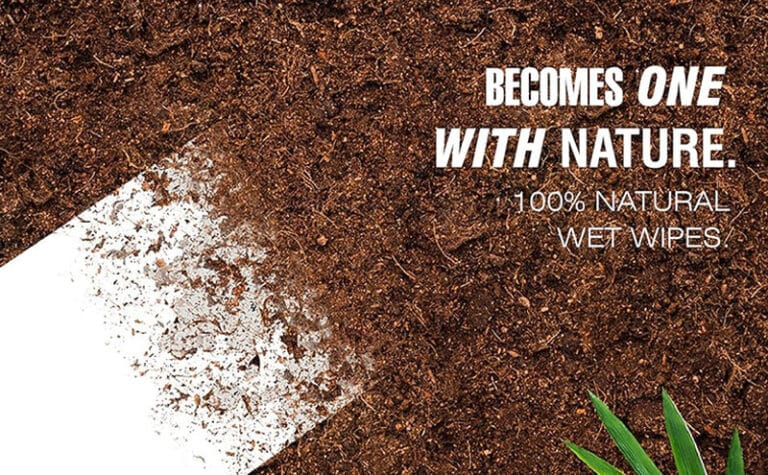
Some paper towels can be composted, provided the paper and its contaminants are compatible with the composting system.
Paper towels contaminated with ordinary food residues may be accepted by some composting programs, but local rules differ. Products exposed to cleaning chemicals, oils unsuitable for the system, or other contaminants may not be appropriate.
Check the requirements of your municipal composting service or home composting system before disposal.
Choosing Products With Environmental Considerations in Mind
When evaluating paper towels, consider the fiber source, recycled content, packaging, manufacturing practices, and available disposal routes.
Avoid relying on a single environmental claim. A meaningful assessment requires understanding the actual product and the conditions under which it is produced and disposed of.
Manufacturers and buyers should also distinguish between material composition and verified environmental performance. Alternative plant fibers or recycled content can be relevant factors, but neither automatically establishes that a product is biodegradable or compostable under all conditions.
Kitchen Paper Towels vs. Wet Wipes
Kitchen paper towels and wet wipes are both used for wiping tasks, but they are designed differently.
Kitchen paper towels are generally supplied dry and are commonly used to absorb liquids, remove loose residue, and dry surfaces.
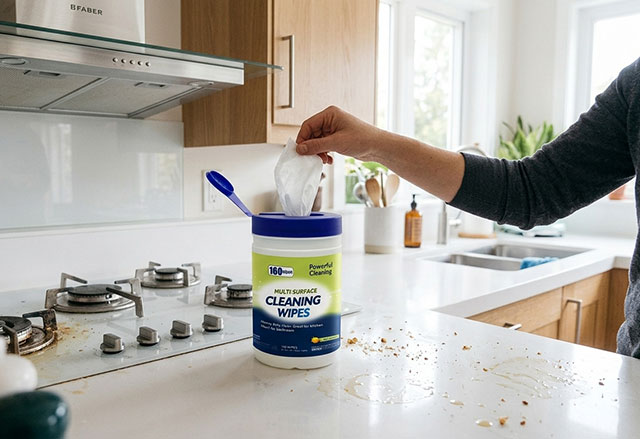
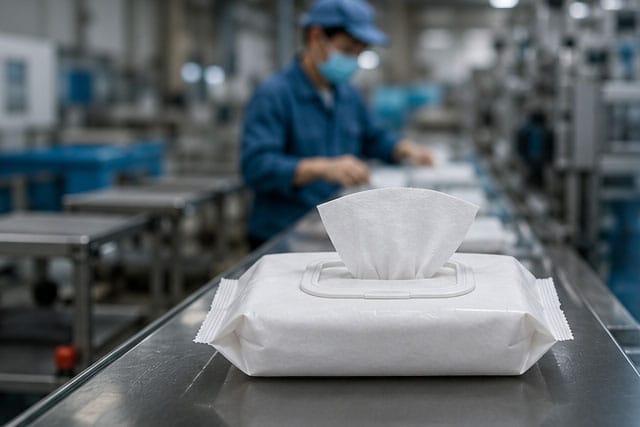
Wet wipes typically combine a nonwoven or other suitable substrate with a liquid formulation. Depending on the product, they may be developed for personal care, household cleaning, industrial applications, or other defined uses.
Neither format is universally better. Paper towels may be suitable for straightforward absorption tasks, while a purpose-designed wet wipe may offer greater convenience for a specific cleaning application.
For businesses developing customized wiping products, material selection should reflect the intended use, formula compatibility, required strength, packaging format, and target market.
SYWIPE provides wet wipes materials and packaging options for brands evaluating substrates and packaging formats for customized wet wipe products.
It is important to distinguish between the manufacturing requirements of paper towels and those of wet wipes. They are different product categories, and the appropriate production process depends on the product being developed.
Frequently Asked Questions
What is the main material in kitchen paper towels?
Most conventional kitchen paper towels are made primarily from cellulose fibers derived from wood pulp. Some products also use recycled fibers or alternative plant-based materials.
What makes a kitchen paper towel more absorbent?
Absorbency depends on fiber properties, sheet structure, thickness, layer construction, and manufacturing conditions. A thicker paper towel is not necessarily more absorbent than a thinner one.
Are bamboo paper towels more environmentally friendly?
Not automatically. Bamboo is a renewable plant resource, but environmental performance depends on cultivation, processing, manufacturing, transportation, and disposal. Specific product information is more useful than relying on the fiber source alone.
Can used kitchen paper towels be recycled?
Used paper towels are generally not accepted in household paper recycling because they are often contaminated and contain short fibers. Check local waste-management guidance for the correct disposal method.
Can kitchen paper towels be composted?
Some can, depending on their composition, contamination, and the requirements of the composting system. Paper towels exposed to cleaning chemicals or unsuitable contaminants should not automatically be treated as compostable.
What should commercial buyers consider when selecting paper towels?
Commercial buyers should evaluate absorbency, wet strength, dimensions, roll or sheet format, dispenser compatibility, packaging, consumption volume, and the intended cleaning application.
Making an Informed Choice
Kitchen paper towels may look like simple disposable products, but their performance depends on fiber selection, sheet construction, and manufacturing quality.
For household buyers, absorbency, convenience, and appropriate disposal are important considerations. For restaurants, distributors, and other commercial buyers, consistency, format, supply requirements, and application suitability can be equally important.
Understanding these differences makes it easier to select a paper product that meets practical needs without paying for features that are unnecessary for the intended use.
For businesses developing customized wiping products, SYWIPE supports OEM and private-label wet wipes development, including material selection, product development, and packaging coordination. You can learn more about our OEM and ODM wet wipes capabilities when evaluating a customized wet wipe product for your market.