Why Wet Wipes Quality Depends on the Manufacturer?
In most buyers’ first encounter with wet wipes manufacturing, the assumption is simple: if two products look the same, they should perform the same. The packaging may be similar, the fabric may feel alike, and even the fragrance might be indistinguishable. Yet, once those products enter real use—across different climates, storage conditions, or retail environments—the differences begin to reveal themselves in ways that are difficult to ignore.
One wipe stays moist after months on a shelf. Another dries out far earlier than expected. One feels soft and stable during use, while another tears or loses structure after a few pulls. From the outside, nothing seemed different at the beginning. But inside the factory, almost everything was.
This is where experienced buyers eventually reach the same conclusion: wet wipes quality is not defined at the product level. Instead, it depends largely on choosing an experienced wet wipes manufacturer that can consistently control every stage of production.
And more importantly, it is defined long before the product ever reaches packaging.
Quality is decided before production begins
Inside a professional wet wipes manufacturing environment, production is not the starting point. It is the midpoint of a much longer chain of decisions.
Before a single roll of nonwoven fabric is loaded into a machine, manufacturers who understand quality are already making invisible choices that will determine the final outcome. The material may look simple on paper—just a sheet and a solution—but the interaction between fiber structure, liquid absorption behavior, and packaging compatibility is complex enough that small differences at this stage can shape everything that follows.
A less experienced manufacturer often treats this stage as a cost discussion. A more advanced one treats it as engineering.
Understanding different wet wipes materials helps explain why some products remain soft and durable while others lose performance over time.
For example, two substrates may appear similar in hand-feel, yet behave completely differently once saturated. One maintains structure under tension, while another weakens gradually as moisture levels shift. These differences are not visible in a sample, but they become very visible in transportation, storage, and long-term use.
The same is true for the formulation itself. A liquid system that feels balanced in a freshly produced batch may begin to drift over time if it was not designed with long-term stability in mind. In some cases, the wipe remains visually unchanged while its microbial resistance weakens. In others, the scent profile slowly shifts as ingredients interact under varying temperatures.
By the time a buyer evaluates a sample, the real decisions have already been made upstream.
The unseen importance of water inside the factory
If there is one component of wet wipes manufacturing that most end users never think about, it is water. Yet in most formulations, water is not just an ingredient—it is the foundation of the entire system.
Inside high-level manufacturing facilities, water is not treated as a utility. It is treated as a controlled material. The reason is simple: any inconsistency in water quality can quietly destabilize everything else built on top of it.
When water passes through multi-stage purification systems, it is not only being cleaned. It is being standardized. The goal is not just purity, but consistency—because consistency is what ensures that a formulation behaves the same way today, tomorrow, and six months later.
In factories where this system is weak or simplified, problems rarely appear immediately. Instead, they emerge later in the lifecycle of the product: subtle odor shifts, moisture imbalance, or microbial instability that only becomes visible after distribution.
From a distance, the difference between factories may not be obvious. But inside production, water often becomes the hidden variable that separates stability from unpredictability.
Why equipment quietly shapes what customers feel
Modern production equipment is only one part of the complete OEM wet wipes manufacturing process, where every production stage influences the final product.
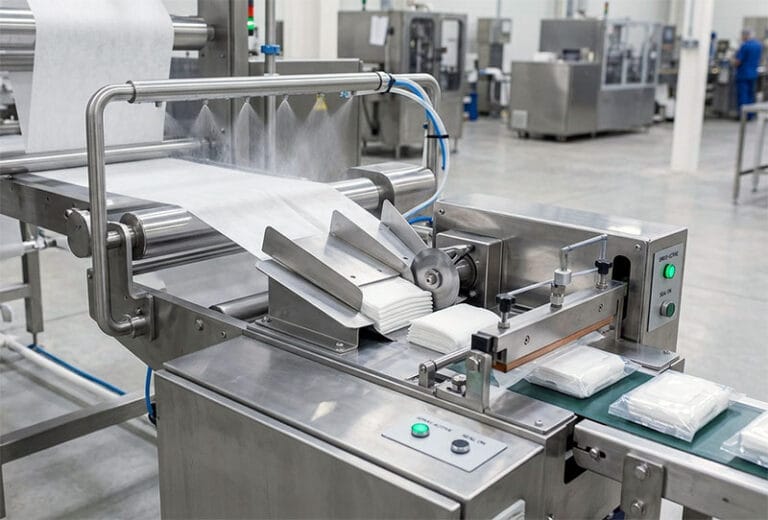
Walk into a modern wet wipes production line, and what stands out is not complexity, but rhythm. Materials move in a controlled sequence, liquid dosage is synchronized with folding and cutting, and sealing happens with precision that leaves little room for deviation.
In this kind of environment, quality is not inspected at the end. It is maintained continuously during production.
When production systems are highly automated, variability decreases. Each unit receives nearly identical treatment, from liquid volume to sealing temperature. This consistency is what allows a brand to scale from small batches to global distribution without changing the user experience.
But when production relies more heavily on manual intervention or loosely controlled processes, variation becomes part of the output. A small difference in sealing pressure, a slight shift in liquid dosage, or even environmental humidity can accumulate into noticeable inconsistencies across batches.
What makes this important is not the machine itself, but what the machine eliminates: unpredictability.
And in consumer products like wet wipes, unpredictability is often what customers perceive as “quality issues,” even when the formulation itself has not changed.
Quality control is not what most people think it is
Many assume quality control is a final checkpoint—a stage where finished products are inspected before shipment. In reality, that approach is already too late for meaningful correction.
In more developed manufacturing systems, quality control behaves more like a continuous monitoring process embedded throughout production. Materials are evaluated before entering the line, conditions are tracked during processing, and finished goods are verified again before release. But the real value is not in any single inspection point. It is in how these points connect.
What matters most is not whether a defect can be detected, but whether it can be prevented from entering the system in the first place.
This is why experienced manufacturers rarely rely on a single layer of inspection. Instead, they build multiple stages of verification that gradually reduce risk as production progresses.
The result is not just fewer defects, but more importantly, fewer surprises after shipment.
Experience is the part that cannot be copied
It is possible to replicate a production line. It is possible to purchase similar equipment. It is even possible to source identical raw materials. What cannot be replicated easily is accumulated experience.
Experience shows itself in subtle decisions that are not always written down. How a formulation behaves in humid climates. How packaging performs after long-distance shipping. How minor variations in fiber structure affect user perception during real-world use.
These are not theoretical insights. They are learned through repeated cycles of production, feedback, and correction.
This is also why two manufacturers with seemingly similar capabilities can produce very different outcomes. One is reacting to problems as they appear. The other has already seen those problems before and designed systems to avoid them.
From the outside, both may look equally capable. From the inside, they are operating on entirely different levels of understanding.
The real meaning of consistency
When buyers evaluate wet wipes quality, the most obvious focus is usually on softness, moisture, or thickness. But in long-term supply relationships, these are not the metrics that matter most.
What matters is consistency.
Consistency is what determines whether a brand can maintain trust across markets, across seasons, and across production cycles. A wipe that performs well once is not difficult to produce. A wipe that performs the same way every time is where manufacturing discipline becomes visible.
Consistency is also where small weaknesses become amplified. A slight variation in raw material sourcing, a minor shift in production environment, or a small deviation in process control may not affect one batch. But across time, these variations accumulate.
This is why experienced buyers often evaluate manufacturers not by samples, but by history.
Why some manufacturers always seem better
When you observe wet wipes manufacturers over time, patterns begin to emerge. The ones that consistently deliver better quality are rarely relying on a single advantage.
Instead, their strength comes from systems that reinforce each other. Stable sourcing ensures raw materials do not fluctuate. Controlled environments reduce external interference. Automated systems maintain repeatability. Quality frameworks ensure problems are detected early. Experience ensures those problems are understood.
It is not any single factor that creates quality. It is the alignment of all factors working together.
And when that alignment exists, quality becomes predictable rather than accidental.
A quiet shift in how brands evaluate manufacturers
n recent years, the way brands choose wet wipes manufacturers has been changing. Price is still part of the discussion, but it is no longer the deciding factor it once was.
Instead, brands are increasingly asking different questions—questions about stability, scalability, and long-term reliability. Not because they have changed priorities, but because they have learned through experience that product quality is not something that can be corrected easily after production begins.
For companies planning to launch or expand their own product lines, partnering with an experienced private label wet wipes manufacturer provides greater flexibility in formulation, packaging, regulatory compliance, and long-term supply chain management.
They are no longer asking “How cheap can this be produced?” but rather “How consistently can this be maintained?”
And that shift, more than anything else, reflects a deeper understanding of what wet wipes manufacturing truly is.
Final reflection
When everything is stripped down to its core, wet wipes quality is not an isolated property of the product itself. It is the outcome of a system—one that begins with raw materials, passes through water, equipment, and process control, and is ultimately shaped by experience and discipline.
This is why two products that look identical can perform so differently in the real world. They were never truly the same product to begin with.
And this is also why, in the wet wipes industry, the manufacturer is not just part of the story.
FAQ
Why do wet wipes from different manufacturers feel different?
Because raw materials, formulations, and production processes vary significantly between manufacturers.
What is the most important factor in wet wipes quality?
Consistency across batches is the most important indicator of manufacturing quality.
Can the same formula produce different results?
Yes. Equipment, water quality, and production conditions can change final performance.
Do certifications guarantee quality?
Certifications ensure compliance systems exist, but do not replace production capability.
Why do some wipes dry out faster?
Usually due to packaging sealing quality or inadequate barrier materials.
How can buyers verify manufacturer quality?
By evaluating production systems, QC processes, and long-term batch consistency.