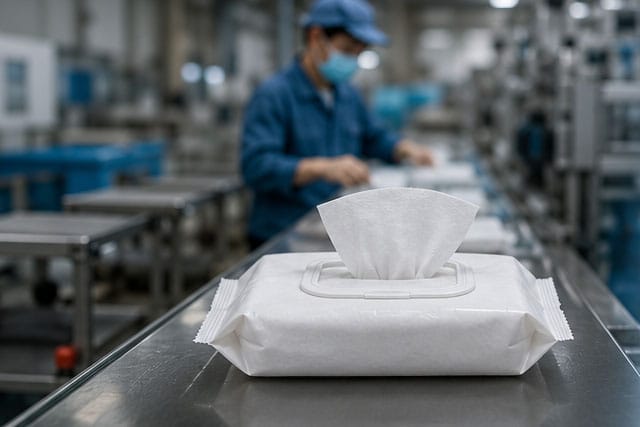
Bamboo vs Lyocell Wet Wipes: Which Is Better?
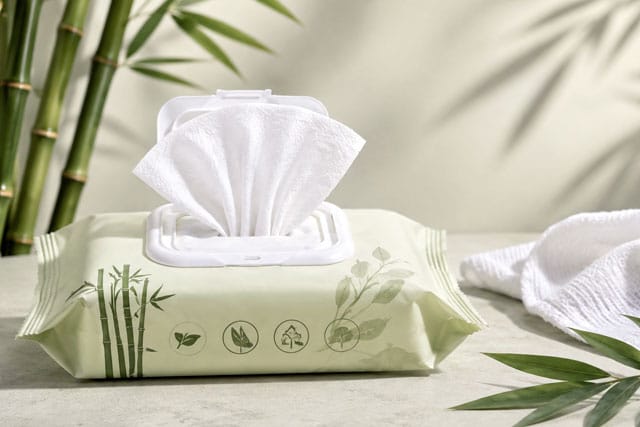
When a brand decides to develop a more sustainable wet wipes product, the material choice often comes down to two names: bamboo and lyocell.
Both sound natural. Both are widely associated with plant-based materials. Both can be used to create soft, absorbent nonwoven wipes.
So, when comparing bamboo vs lyocell wet wipes, which one is actually better?
The answer is not as simple as choosing the material with the strongest sustainability claim. A successful wet wipe has to balance softness, strength, liquid absorption, skin feel, biodegradability, production requirements, and ultimately the positioning of the product.
For brands developing baby wipes, personal care wipes, facial wipes, or other eco-conscious products, understanding the difference between bamboo and lyocell can make the product development process much easier.
Bamboo and Lyocell Start With Different Stories
The first thing to understand is that bamboo and lyocell are not exactly the same type of material.
Bamboo is a plant-based raw material. Bamboo grows quickly and can be processed into cellulose-based fibers for nonwoven applications. In the wet wipes industry, bamboo-based substrates are often selected because they offer a natural product story, softness, and biodegradability.
Lyocell, on the other hand, describes a fiber production process, rather than one specific plant.
Lyocell fibers are regenerated cellulose fibers made from cellulose pulp. For example, LENZING™ Lyocell fibers are derived from renewable wood sources and produced through a solvent-spinning process in which more than 99% of the solvent is recovered and reused.
This distinction matters.
When a supplier describes a wipe as “bamboo,” it is worth asking what type of bamboo substrate is actually being used and how the fiber is produced. Likewise, “lyocell” does not automatically mean that every lyocell product has exactly the same raw material source or environmental profile.
For product developers, the better question is therefore not simply “Which material is greener?”
It is:
“Which material gives this particular wet wipe the performance and sustainability profile my market needs?”
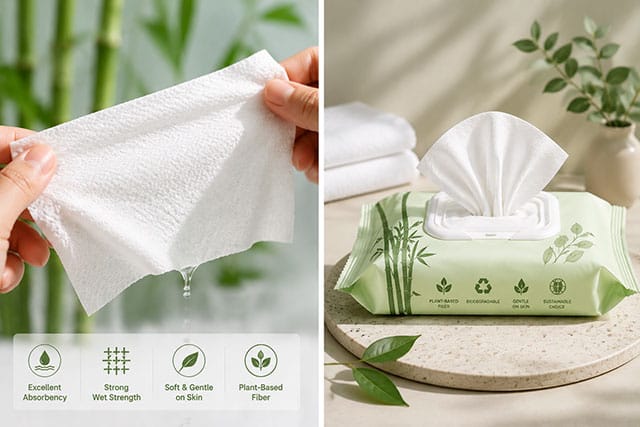
How Bamboo Wet Wipes Perform
Bamboo has become increasingly popular in biodegradable and eco-focused wet wipes.
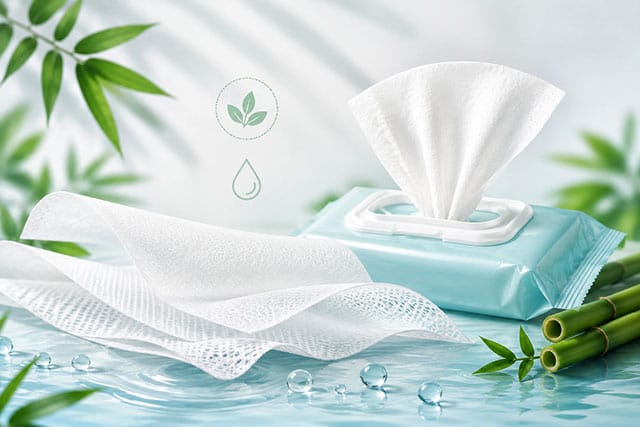
The appeal is easy to understand. Bamboo is a rapidly renewable plant resource, and bamboo-based fibers can provide a soft, comfortable substrate for personal care products.
For brands positioning a product around natural materials, bamboo can also be an attractive marketing story. A bamboo wipe can communicate a plant-based alternative to conventional synthetic nonwovens while fitting naturally into a broader sustainable product range.
Performance, however, depends on the actual fiber and nonwoven construction.
The bamboo content alone does not determine whether a wipe will feel soft, hold liquid effectively, or remain strong when saturated. Fiber length, fiber blend, basis weight, hydroentanglement, embossing, and lotion formulation can all influence the final product.
This is why material selection should always be considered together with the complete wipe construction rather than treated as a single-variable decision.
SYWIPE, for example, lists bamboo fiber as one of its wipe fabric options and positions it for eco-friendly applications.
For brands developing a biodegradable wipe at a competitive price point, bamboo can therefore be a practical starting point.
Why Lyocell Is Becoming Important for Premium Wipes
Lyocell takes a different route.
Instead of focusing primarily on the plant name, lyocell focuses on the technology used to transform cellulose into fiber.
For nonwoven applications, VEOCEL™ Lyocell is specifically developed for personal care and hygiene products. Lenzing describes the fiber as offering liquid management, biodegradability, and compostability, while its manufacturing process uses more than 99% solvent recovery.
That combination makes lyocell particularly interesting for brands looking beyond basic biodegradable positioning.
A well-designed lyocell substrate can offer a soft hand feel while maintaining good wet and dry strength. Its ability to manage liquid is also important in wet wipes, because the substrate has to distribute the lotion throughout the sheet rather than simply absorb it in one area.
This can be especially valuable for premium baby wipes, facial wipes, sensitive-skin products, and personal care wipes where softness and consistency are central to the consumer experience.
Lenzing also notes that lyocell fibers have high strength among cellulose fibers and can be blended with other materials to adjust performance and functionality.
That flexibility gives product developers more room to fine-tune the final wipe.
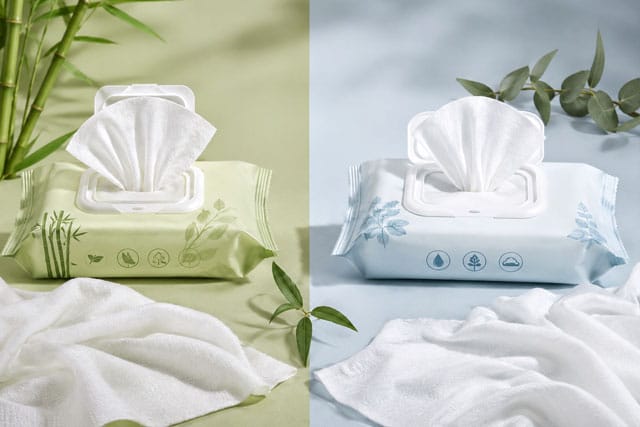
Bamboo vs Lyocell: Which One Is Softer?
If two wipes are made with similar basis weight and nonwoven construction, both bamboo-based and lyocell-based substrates can feel soft.
But softness is not determined by fiber name alone.
The fiber diameter, fiber structure, web formation, bonding method, basis weight, and finishing process all affect the final hand feel.
For premium personal care products, lyocell can be attractive because the fiber can provide a smooth and comfortable nonwoven structure. For everyday biodegradable wipes, bamboo can also deliver a soft feel when the substrate is properly engineered.
So, there is no universal winner.
If your priority is premium softness and refined skin feel, lyocell may deserve closer consideration.
If your priority is plant-based positioning combined with cost-conscious product development, bamboo may be the more practical option.
Which Absorbs More Liquid?
Wet wipes are not just pieces of fabric. Their ability to absorb, hold, and distribute liquid directly affects how the product performs in the consumer’s hand.
Cellulose-based fibers are naturally suited to liquid absorption, but the final performance depends on the entire nonwoven structure.
Lyocell is particularly interesting in this area. VEOCEL™ Lyocell fibers are designed for nonwoven applications and are described by Lenzing as providing uniform liquid distribution within the nonwoven.
That can help manufacturers develop wipes with consistent lotion distribution.
Bamboo-based substrates can also provide good absorbency, but performance will vary depending on whether the wipe uses bamboo alone or combines bamboo with other cellulose fibers.
For this reason, a manufacturer should evaluate absorption capacity, liquid retention, lotion distribution, and wet strength together rather than selecting a material based on absorbency claims alone.
What About Wet Strength?
This is one area where product development becomes more technical.
A wet wipe needs to absorb liquid without falling apart during use. A wipe that feels soft when dry but loses too much strength after becoming saturated may create a poor consumer experience.
Lyocell is known for its relatively high strength among cellulose fibers, making it useful where a manufacturer needs to balance softness with durability.
Bamboo-based substrates can also be engineered for sufficient wet strength, especially when combined with suitable fiber structures or blends.
The important point is that wet strength is a property of the finished nonwoven, not simply the raw material name.
For a private label brand, requesting actual substrate specifications and wet-strength testing is therefore more useful than asking whether bamboo or lyocell is “stronger.”
Which Is More Sustainable?
This is where the comparison becomes more complicated.
It is tempting to say that bamboo is automatically more sustainable because bamboo grows rapidly. It is equally tempting to say that lyocell is automatically better because it uses a closed-loop manufacturing process.
Neither statement tells the complete story.
The environmental profile of a wipe depends on raw material sourcing, fiber production, chemical management, water and energy consumption, transportation, product construction, packaging, and end-of-life conditions.
Lyocell has a strong sustainability advantage when the fiber comes from a responsible source and is produced using a well-controlled closed-loop process. Lenzing states that its lyocell production recovers more than 99% of the solvent used in the process and that its fibers are derived from renewable wood sources.
Bamboo can also be a valuable renewable feedstock for biodegradable wipes, but the word “bamboo” alone does not provide enough information about how the final fiber was manufactured.
This is why responsible brands should look beyond the front-of-pack sustainability message.
Ask where the cellulose comes from.
Ask how the fiber is processed.
Ask whether the material has relevant certifications.
And ask for documentation supporting biodegradability or compostability claims where those claims are important to the target market.
Bamboo vs Lyocell Wet Wipes: A Practical Comparison
Feature | Bamboo-Based Wipes | Lyocell Wipes |
Raw material story | Bamboo-based plant resource | Regenerated cellulose, commonly wood-based |
Softness | Soft when properly engineered | Excellent potential for soft, smooth substrates |
Absorbency | Good, depending on construction | Very good liquid management potential |
Wet strength | Depends on fiber and structure | Generally strong among cellulose fibers |
Sustainability | Strong renewable-material story | Strong traceability and closed-loop options |
Premium positioning | Good | Excellent |
Cost positioning | Often attractive for eco-focused products | Typically more premium |
Product development | Flexible | Highly suitable for premium nonwovens |
Best fit | Eco-conscious everyday wipes | Premium personal care and hygiene wipes |
The table should be viewed as a product-development guide rather than an absolute ranking. A well-engineered bamboo wipe can outperform a poorly designed lyocell wipe, just as a carefully engineered lyocell substrate can outperform a basic bamboo substrate.
Which Material Is Better for Baby Wipes?
For baby wipes, the decision becomes more sensitive because softness, lotion distribution, wet strength, and skin comfort all matter.
A bamboo wipe can work well for a brand building a natural and biodegradable baby-care story.
Lyocell can be particularly attractive for premium baby wipes where the brand wants to emphasize a soft substrate, refined texture, and responsible fiber sourcing.
The formula is just as important as the fabric.
A premium substrate cannot compensate for an unsuitable lotion system, excessive fragrance, poor preservation, or inconsistent manufacturing.
That is why the best baby wipe development process evaluates the substrate and formula together.
Which Is Better for Facial and Personal Care Wipes?
For facial wipes and premium personal care products, the consumer experience becomes even more important.
A wipe used on the face needs to feel soft, smooth, and comfortable rather than rough or overly fibrous.
Lyocell can be a strong candidate for these applications because of its softness, strength, and liquid-management characteristics. Lenzing specifically positions VEOCEL™ Lyocell for beauty, personal care, and hygiene applications.
Bamboo remains attractive when the product’s main differentiation is natural, plant-based, and biodegradable positioning.
The final choice should therefore follow the brand concept rather than the material trend.
Bamboo or Lyocell: What Should a Brand Choose?
Imagine two brands preparing to launch new wet wipes.
The first wants an affordable biodegradable wipe for supermarkets. The packaging emphasizes plant-based materials and everyday sustainability. The product needs to perform reliably without moving too far into the premium price range.
Bamboo may be an excellent direction.
The second brand is launching a premium facial or baby-care wipe. Its customers care about softness, responsible sourcing, refined product quality, and a stronger sustainability story.
Lyocell may make more sense.
Neither brand is making the “wrong” choice.
They are simply solving different product problems.
That is the most important lesson when comparing bamboo vs lyocell wet wipes: the best material is the one that fits the product’s intended performance, target customer, price position, and sustainability requirements.
What Should You Ask a Wet Wipes Manufacturer?
Before approving a substrate, brands should ask the manufacturer for more than a material name.
Request the fiber composition, basis weight, sheet size, wet and dry strength, absorption performance, biodegradability or compostability documentation where applicable, and information about the fiber source.
It is also useful to test several prototypes.
A wipe that looks excellent on paper may feel completely different once it is saturated with lotion and used on skin.
For brands developing a new product, the manufacturer should be able to adjust the substrate, lotion loading, sheet size, embossing, and packaging until the finished wipe matches the intended market position.
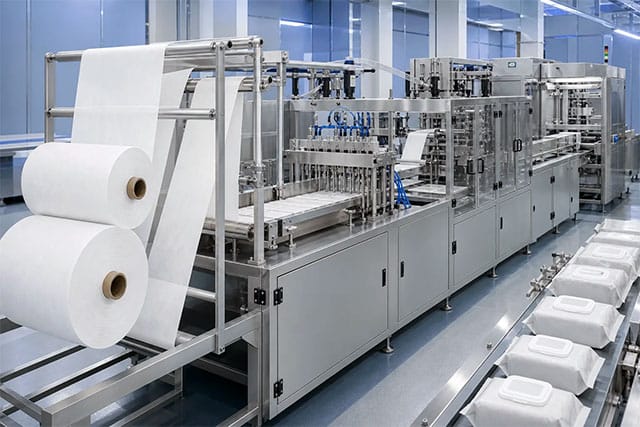
This is where working with an experienced wet wipes manufacturer becomes important. Material selection is not an isolated purchasing decision; it is part of product development, testing, and manufacturing.
The Better Question Is Not Bamboo or Lyocell
Bamboo and lyocell should not be treated as competing “good” and “bad” materials.
Both can play an important role in the development of more sustainable wet wipes.
Bamboo can provide a compelling renewable-material story and works well for brands looking for biodegradable, plant-based wipe solutions. Lyocell offers a highly engineered cellulose fiber with strong softness, liquid-management, strength, and traceability potential. Lenzing’s VEOCEL™ range is specifically designed for nonwoven applications and responsible personal care products.
The better question is:
What does your wet wipe need to achieve?
Once that is clear, the right material becomes much easier to identify.
For brands that are still comparing substrates, SYWIPE provides different wet wipes materials for product development, including bamboo fiber and other nonwoven options. The final material can be selected according to the product’s performance, sustainability goals, and target market.
If you are developing a new eco-friendly or premium wet wipes line, the next step is to compare the actual substrate samples rather than relying on material names alone. SYWIPE also provides private label wet wipes solutions, covering material selection, formulation, packaging, sampling, and mass production for international brands.
Frequently Asked Questions
Is bamboo better than lyocell for wet wipes?
Not necessarily. Bamboo can be a strong choice for biodegradable and cost-conscious products, while lyocell can be particularly suitable for premium wipes requiring softness, liquid management, and high-quality cellulose fibers.
Are lyocell wet wipes biodegradable?
Certain lyocell fibers are certified biodegradable and compostable under specified conditions. However, the biodegradability of a finished wet wipe depends on its complete material composition and construction, so brands should verify the specific product documentation rather than assuming every lyocell wipe has the same end-of-life performance.
Are bamboo wet wipes biodegradable?
Bamboo-based cellulose substrates can be biodegradable, but the exact claim depends on the fiber processing method, final wipe composition, and applicable testing. Brands should request documentation from the manufacturer before making specific biodegradability or compostability claims.
Are lyocell wipes more expensive than bamboo wipes?
Lyocell can be positioned as a more premium substrate, but actual costs depend on fiber specification, basis weight, blend, production volume, and the overall product design. The best comparison should be based on the finished wipe rather than fiber price alone.
Which is better for premium baby wipes?
Lyocell can be an attractive option for premium baby wipes because of its softness, strength, and liquid-management characteristics. Bamboo can also be suitable when the brand prioritizes plant-based positioning and biodegradable materials.
Can bamboo and lyocell be blended?
Yes. Cellulose fibers can be combined to adjust softness, strength, absorbency, and cost. The appropriate blend depends on the performance target and manufacturing process.
Final Takeaway
There is no universal winner in the bamboo vs lyocell wet wipes debate. Choose bamboo when the product needs a strong plant-based story, biodegradable positioning, and practical cost control. Choose lyocell when premium softness, engineered performance, liquid management, and responsible fiber sourcing are higher priorities.
For many brands, the smartest approach is not to choose a material based on marketing claims alone. Develop samples, test the finished wipe, review the fiber documentation, and evaluate the material against the needs of the target market. That is how a sustainable wet wipe becomes more than a green product claim—it becomes a product that consumers actually want to use.
Whether you choose sustainable bamboo or lyocell fibers, finding the right manufacturing partner is crucial for your brand’s success. As a trusted OEM wet wipes manufacturer, Sywipe provides end-to-end custom formulation and eco-friendly production tailored to your exact market specifications.