What Ingredients Are Used in Wet Wipes?
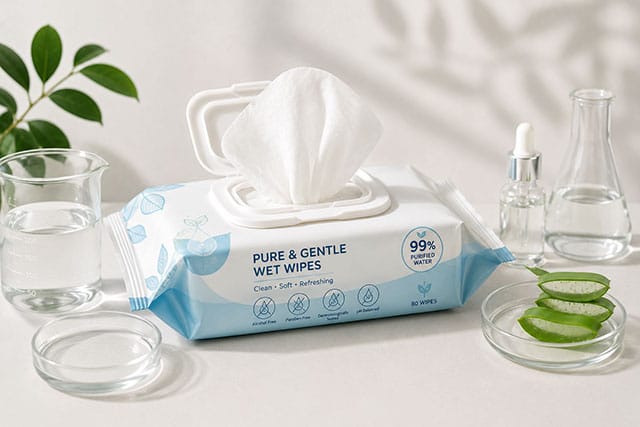
A wet wipe can look deceptively simple. Open the pack, pull out a soft sheet, and it seems as though the product is little more than fabric and water.
But the liquid inside a wet wipe is usually a carefully developed formulation.
So, what ingredients are used in wet wipes?
Most formulations start with purified water and then combine selected functional ingredients to achieve the desired cleaning performance, skin feel, preservation, stability, and sensory experience. The exact formula changes according to the type of wipe and its intended use.
A baby wipe, facial wipe, household cleaning wipe, and disinfecting wipe should not be expected to use the same formulation.
The important question is therefore not simply which ingredients are present, but why each ingredient is there and how the ingredients work together.
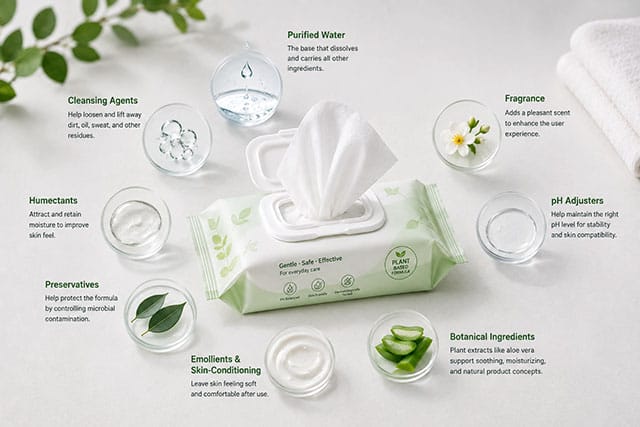
Purified Water Forms the Base
Water is usually the largest component of a wet wipe liquid.
Its job sounds simple, but water quality is critical because it becomes the carrier for every other ingredient in the formulation.
Purified water helps dissolve or distribute functional ingredients and allows the finished solution to spread throughout the nonwoven substrate.
Because wet wipes are moist products stored for relatively long periods, manufacturers also need to control microbiological quality during water treatment and production.
For this reason, commercial wet wipe manufacturing relies on controlled water systems and quality procedures rather than ordinary untreated water.
Cleansing Agents Help Remove Dirt
Water alone is not always enough to remove oils, dirt, sweat, makeup, or other residues.
Depending on the application, wet wipe formulations may therefore contain mild cleansing agents or surfactants.
These ingredients help loosen substances from the skin or another surface so they can be lifted away by the wipe.
The choice of cleansing agent depends heavily on the product.
A baby wipe needs a very different level of cleansing from an industrial wipe designed to remove grease.
This is why a formulation should always be developed around the intended application instead of starting with a generic ingredient list.
Humectants Improve Skin Feel
Some personal care wipes contain humectants such as glycerin.
A humectant helps attract and retain moisture, which can contribute to a smoother and more comfortable skin feel.
This can be useful for baby wipes, facial wipes, body wipes, and other products designed for frequent skin contact.
However, more humectant does not automatically mean better performance. Too much can change the way the wipe feels, affect liquid viscosity, or create a sticky sensation.
The goal is balance.
Preservatives Help Protect the Formula
One of the biggest differences between a dry tissue and a wet wipe is the presence of water.
A moist environment can support microbial growth if it is not properly controlled. That is why many wet wipe formulations use a preservation system.
Preservatives help protect the finished product during its intended shelf life and use.
The specific preservation system depends on factors such as the formula, pH, packaging, raw materials, target market, and product category.
For brands, this is an important point: “preservative-free” should not automatically be treated as synonymous with “safer.”
A wet wipe still needs an effective strategy for controlling microbial contamination. The appropriate approach should be determined through formulation development and testing.
Emollients and Skin-Conditioning Ingredients
Some wipes are designed to leave the skin feeling soft after use.
These products may include emollients or other skin-conditioning ingredients that help improve the sensory experience.
Such ingredients can be particularly relevant to baby care, facial cleansing, and premium personal care wipes.
Again, the formulation needs to remain balanced.
A wipe that leaves too much residue may feel uncomfortable, while a formula with insufficient conditioning may feel drying.
The desired skin feel is therefore part of the product specification rather than an accidental result.
Botanical Ingredients Can Support a Product Concept
Aloe vera and other botanical extracts are sometimes used in personal care wipes.
They may be selected to support a soothing, moisturizing, natural, or premium product concept.
But “plant-based” does not automatically mean that an ingredient is suitable for every formula.
Botanical extracts can affect color, odor, stability, preservation, and regulatory considerations. They should therefore be selected based on the finished formulation rather than simply added because they sound appealing on a label.
Fragrance Is a Choice, Not a Requirement
Some wet wipes have a recognizable scent.
Others are completely fragrance-free.
Fragrance can create a particular sensory experience or help mask the natural odor of certain raw materials. But it does not provide the basic wiping function.
For baby, facial, sensitive-skin, or intimate-care products, a brand may choose a fragrance-free formulation depending on its target market.
The choice should be driven by the product concept and consumer expectations rather than by the assumption that every wet wipe needs to smell pleasant.
pH Adjusters Help Maintain Formulation Balance
A formulation’s pH can affect stability, preservation, ingredient compatibility, and skin feel.
Manufacturers may therefore use pH-adjusting or buffering ingredients to achieve and maintain the desired range.
The target depends on the product.
A personal care wipe and a surface cleaning wipe may require very different formulation conditions.
This is another example of why ingredients cannot be selected independently. Changing one ingredient can influence several other properties of the formulation.
Why Ingredient Combinations Matter
The most important thing to understand about wet wipe ingredients is that they do not work independently.
Imagine a formula with excellent cleansing performance but poor skin feel.
Or a gentle formula that cannot maintain microbiological stability.
Or a moisturizing formula that leaves an unpleasant residue.
Each of these products may contain individually acceptable ingredients, but the overall formulation would still be unsuccessful.
Professional formulation development therefore looks at the interaction between ingredients rather than simply counting how many ingredients are included.
Baby Wipes Need a Different Approach
Baby wipes provide a good example of why formulation matters.
A baby’s skin is a very different use environment from a kitchen counter or industrial surface.
A baby wipe formula typically focuses on gentle cleansing, skin comfort, appropriate preservation, and a pleasant wiping experience.
Depending on the product concept, brands may choose purified water-based formulas, mild cleansing systems, humectants, selected skin-conditioning ingredients, and fragrance-free options.
The nonwoven substrate matters too.
The liquid formula and the substrate need to work together so that the wipe is soft, evenly saturated, and easy to use.
For brands developing baby products, SYWIPE provides different baby care wipes solutions based on product positioning and material requirements.
Household and Industrial Wipes Are Different
Now consider a household cleaning wipe.
The primary goal may be removing grease, dirt, dust, or food residues from a surface. The formulation can therefore prioritize cleaning performance rather than the same skin-conditioning characteristics expected from a baby wipe.
Industrial wipes may require even more specialized formulations.
They can be designed around specific residues, equipment, oils, or manufacturing environments.
This is why the phrase “wet wipe ingredients” covers a very broad range of formulations.
The application always comes first.
How Manufacturers Choose Wet Wipe Ingredients
When a brand approaches a manufacturer with a new wet wipe idea, formulation development should begin with questions rather than ingredients.
Who will use the product?
Where will it be used?
What should it remove?
How often will it be used?
Should it be fragrance-free?
What kind of skin feel is expected?
Which market will the product enter?
What claims will appear on the packaging?
Once those questions are answered, the formulation can be developed around the intended product performance.
The formula then needs to be evaluated for stability, microbiological protection, pH, compatibility with the substrate, packaging compatibility, and other relevant quality requirements.
This is where wet wipes R&D becomes important. A professional development process connects formulation with substrate, packaging, manufacturing, and testing instead of treating them as separate decisions.
Ingredients and Materials Must Work Together
A liquid formulation cannot be developed completely independently of the wipe material.
A highly absorbent substrate may hold more liquid. A different fiber blend may release the liquid differently. A thicker sheet may require a different saturation level from a lightweight wipe.
This relationship is why brands should consider the formulation and wet wipes materials together during product development.
The best formula on paper may not create the best finished wipe if it does not interact properly with the selected substrate.
Frequently Asked Questions About Wet Wipe Ingredients
What is the main ingredient in wet wipes?
Purified water is commonly the main component of the liquid formulation. Other ingredients are added according to the product’s intended function.
Do wet wipes contain preservatives?
Many water-based wet wipes require a preservation system to help control microbial growth. The exact system depends on the formulation and product requirements.
Are wet wipes made with alcohol?
Some wipes contain alcohol, particularly certain disinfecting or cleaning products. Many baby and personal care wipes do not require alcohol.
Are baby wipes fragrance-free?
Some are, and some are fragranced. Fragrance-free formulations are commonly offered for consumers who prefer products without added fragrance.
Do all wet wipes use the same ingredients?
No. Ingredients vary considerably depending on whether the product is intended for babies, personal care, pets, household cleaning, industrial use, or another application.
A Wet Wipe Formula Is More Than an Ingredient List
A good wet wipe formulation is not created by putting as many “good” ingredients as possible into a bottle.
It is created by understanding what the product needs to accomplish and selecting ingredients that work together to achieve that result.
Water provides the base. Cleansing agents support cleaning. Humectants and conditioning ingredients influence skin feel. Preservatives protect the moist formulation. Fragrance and botanical ingredients can shape the sensory and marketing concept, while pH adjustment helps maintain formulation balance.
When these elements are developed alongside the right substrate and packaging, the result is a wet wipe that performs consistently from the first sheet to the last.
That is the real purpose of wet wipe formulation: not simply to create a liquid, but to create a liquid that works with the entire product.