How to Choose a Wet Wipes Manufacturer in 2026 (Industry Trends Perspective)
In 2026, choosing a wet wipes manufacturer rarely begins with certainty. Most buyers do not start with a clear decision or a fixed supplier list. Instead, the process often begins with uncertainty shaped by urgency—launching a new product line, replacing an unstable supplier, or expanding into a new market where compliance requirements are stricter than before.
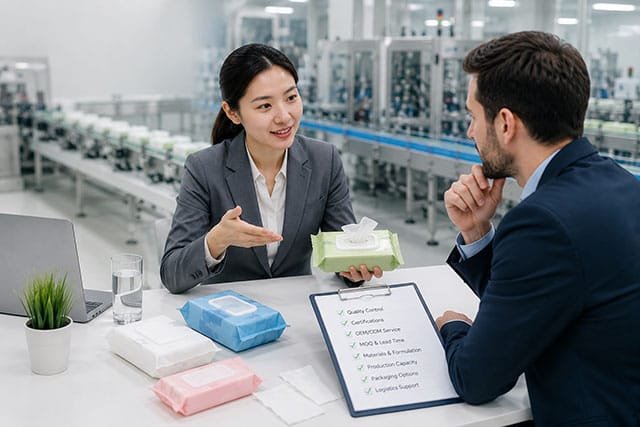
At first glance, the sourcing process still feels familiar. Buyers request samples, compare pricing, and evaluate packaging options. Nothing appears dramatically different from how procurement worked in the past. But as conversations deepen, a subtle shift becomes visible. Buyers are no longer just evaluating products—they are evaluating systems behind those products.
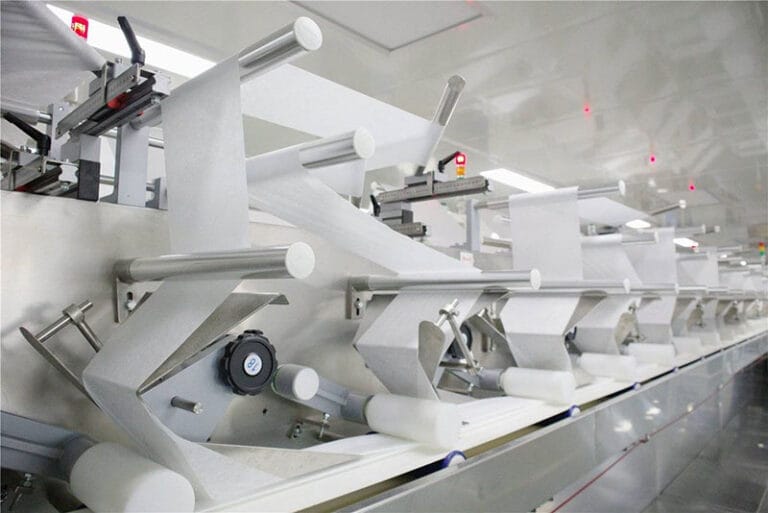
To understand this shift properly, it is important to first recognize how wet wipes manufacturing actually works beyond the surface level of sampling. A deeper understanding of wet wipes manufacturing process overview in OEM production systems helps explain why early impressions often fail to reflect long-term production reality.
Why the industry is quietly changing its definition of “quality”
For many years, quality in wet wipes manufacturing was relatively easy to judge. If a sample felt soft, had enough moisture, and passed basic packaging inspection, it was often considered acceptable. The decision-making process was fast and heavily influenced by visible product attributes.
However, in 2026, this definition of quality is no longer sufficient. Buyers have begun to experience a recurring problem: samples that look perfect do not always translate into consistent mass production.
When production scales, small differences begin to appear. These differences are not always dramatic, but they are persistent. A slight change in fabric density, a minor adjustment in liquid formulation, or a variation in sealing pressure can gradually affect product performance across shipments.
Because of this, buyers are shifting their attention away from isolated sample evaluation and toward long-term production stability. Instead of asking whether a product is good once, they are asking whether it remains consistent over time.
This is where supplier selection criteria for evaluating reliable wet wipes manufacturers becomes a more important framework than traditional sample-based judgment.
The invisible gap between samples and mass production
Samples are still an essential part of the evaluation process, but their role has fundamentally changed. They are no longer seen as confirmation of capability—they are now seen as a starting point for discussion.
Manufacturers typically produce samples under controlled conditions. Materials are carefully selected, machine settings are optimized, and environmental variables are minimized. In this environment, nearly every product appears stable and well-controlled.
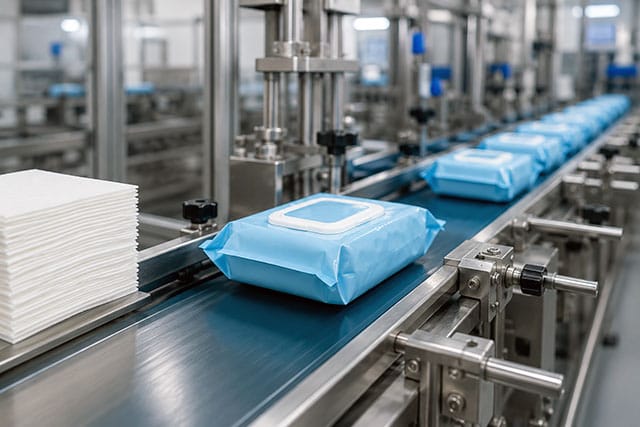
But mass production is different. Once orders scale, variables multiply. Raw material batches may change. Machines operate continuously over longer cycles. Packaging lines run at higher speeds. Each of these factors introduces small deviations that are difficult to detect in isolation but meaningful when combined.
This is why experienced buyers no longer rely on sample impressions alone. Instead, they begin evaluating how manufacturers behave under repeated production cycles.
Compliance is no longer a checklist—it is a system expectation
Another major transformation in the industry is the role of compliance. In earlier years, compliance was often treated as a final documentation step, something reviewed after product development was complete.
In 2026, this approach is no longer sufficient. Regulatory expectations in global markets have increased significantly, especially in regions such as Europe and North America where environmental standards, chemical restrictions, and labeling accuracy are strictly enforced.
As a result, compliance is now embedded earlier in the supplier selection process. Buyers are no longer simply asking whether certifications exist. Instead, they are trying to understand whether compliance is integrated into daily production behavior.
This shift is important because it reflects a deeper change: compliance is no longer a static document—it is a dynamic production capability.
Materials are no longer judged by type, but by behavior
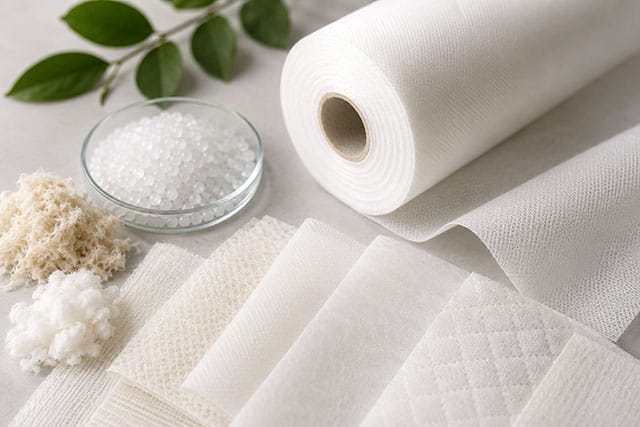
Traditionally, material selection was one of the most straightforward parts of wet wipes manufacturing. Buyers compared options such as bamboo fiber, viscose, or polyester-based nonwovens and made decisions based on softness, cost, or availability.
In 2026, this approach is no longer sufficient. Material choice is now evaluated through performance behavior rather than category labels.
A material that performs well in a sample environment may behave differently under continuous production, high-speed packaging, or long-distance logistics conditions. Moisture retention, structural stability, and fiber integrity can all shift depending on real-world usage scenarios.
Because of this, material evaluation has become part of system-level thinking rather than isolated selection.
Many buyers therefore revisit wet wipes material composition and performance in nonwoven production systems to better understand how materials interact with production conditions rather than viewing them in isolation.
Why scaling exposes the real differences between manufacturers
One of the most important turning points in supplier evaluation happens when production scales.
A manufacturer that performs well in small batches may not necessarily maintain the same level of consistency when production increases significantly. At higher volumes, even minor variations in raw materials or machine calibration can become visible in the final product.
This is often where buyers begin to notice meaningful differences between suppliers. Not in samples, but in repeat orders. Not in controlled environments, but in real logistics conditions.
Scalability, therefore, is no longer a secondary capability. It has become one of the core indicators of manufacturing maturity.
For brands planning expansion or multi-market distribution, understanding minimum order quantity and OEM production scalability in wet wipes manufacturing becomes an essential part of risk management.
From supplier selection to long-term production architecture
As the industry evolves, buyer expectations are also changing. The relationship between brands and manufacturers is no longer purely transactional.
Instead of asking “Who can produce this order?”, many buyers are now asking a more strategic question: “Who can grow with my brand?”
This shift reflects a deeper transformation in global sourcing behavior. Manufacturers are no longer evaluated only on production capability, but on their ability to support continuous product evolution, packaging changes, and market expansion.
In this context, the role of a manufacturer becomes closer to a long-term production partner rather than a one-time supplier. This is why many brands eventually move toward working with a trusted global wet wipes manufacturing partner with long-term OEM capability, rather than switching suppliers frequently based on short-term conditions.
How decision-making in 2026 differs from the past
If we look at how sourcing decisions were made in the past, the process was relatively linear. Buyers identified suppliers, compared samples, negotiated pricing, and placed orders.
In 2026, the process is no longer linear. It is iterative. Buyers move back and forth between evaluation stages, rechecking stability, compliance, and scalability as new information emerges.
This is why modern sourcing decisions take longer but are also more strategic. The cost of choosing incorrectly has increased, especially for brands operating in global markets where consistency directly affects brand trust.
The hidden factor behind long-term supplier success
While many factors influence supplier selection, one underlying theme consistently determines long-term success: system stability.
Manufacturers that succeed in 2026 are not necessarily those that offer the lowest price or the most impressive samples. Instead, they are the ones that maintain predictable output across changing conditions.
This includes maintaining consistency across raw material variations, production cycles, and logistical challenges. Over time, this predictability becomes more valuable than any single product attribute.
Common Questions About Choosing a Wet Wipes Manufacturer in 2026
Why do wet wipes samples often differ from mass production?
Because samples are produced under controlled conditions, while mass production introduces variability in materials, machine settings, and scaling factors.
What matters more today—price or stability?
Stability has become more important for long-term brand development, especially in international markets.
How should manufacturers be evaluated in 2026?
They should be evaluated as complete production systems, not just based on sample performance.
Is compliance still only about certification?
No. Compliance is now part of ongoing production control and must remain stable throughout manufacturing cycles.
Why is scalability important when choosing a manufacturer?
Because differences between suppliers often only become visible when production volumes increase.
Final Perspective
In 2026, choosing a wet wipes manufacturer is no longer a simple sourcing decision. It is a gradual evaluation of systems, consistency, and long-term scalability.
The most reliable manufacturers are not always the ones that appear strongest at the beginning. They are the ones that continue to perform consistently as production scales, regulations evolve, and market expectations become more demanding.
And in that shift, the meaning of “choosing a manufacturer” is quietly being redefined—from selecting a supplier to selecting a production system that can sustain long-term brand growth.