How to Choose the Right Industrial Wipes for Your Needs?
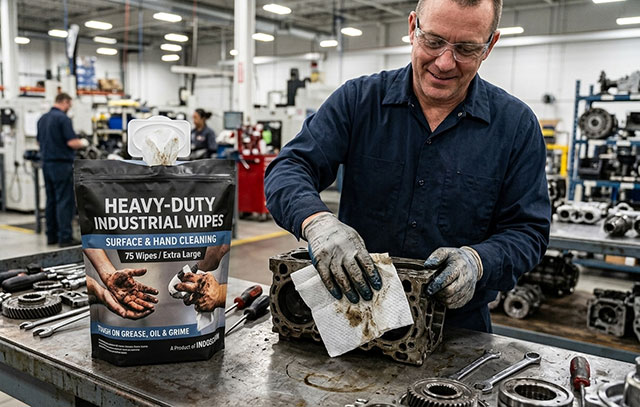
Walk into an automotive workshop, a manufacturing plant, and a maintenance facility, and you may notice something they all have in common: workers need to clean as they work.
But the type of cleaning is rarely the same.
A technician may need a wipe that can handle oil around an engine component. A maintenance worker may need something absorbent for liquid spills. On a production line, strength and low lint can matter more than anything else. In another workplace, a large-format wipe may simply be more practical because workers are cleaning larger surfaces or heavily soiled hands.
That is why choosing industrial wipes is not simply a matter of picking the thickest or strongest product available. The better approach is to start with the job itself and then match the wipe to the working conditions.
Start With the Cleaning Task
The first question is simple: what will the wipe actually be used for?
Industrial wiping tasks can range from cleaning hands and tools to wiping machinery, work surfaces, components, and equipment. Some applications involve liquids, while others involve grease, dust, ink, adhesives, or general workshop residues.
For example, a technician who needs quick hand cleaning during vehicle maintenance may prefer a different wipe from a production worker wiping down equipment at the end of a shift.
This distinction is important because a wipe designed for hands does not automatically need the same characteristics as one designed for industrial surfaces.
Before choosing a product, it helps to define the primary application rather than trying to create one wipe for every possible task.
Material Makes a Difference
Once the application is clear, the next consideration is the wipe material.
Different nonwoven materials offer different combinations of softness, strength, absorbency, texture, and resistance to tearing. A softer material may be more suitable when the wipe comes into frequent contact with hands, while a stronger construction can be useful for demanding workshop tasks.
For brands developing their own professional wiping products, material selection can therefore be part of the product development process rather than an afterthought.
The right industrial wipes should provide the performance expected by the end user while also matching the intended price point and market positioning.
Consider Absorbency and Strength Together
Absorbency is important when a wipe needs to pick up liquids, but absorbency alone does not determine whether a wipe is suitable for professional work.
Imagine a maintenance worker dealing with a spill around machinery. A highly absorbent wipe may pick up the liquid quickly, but if it tears during use, the worker may need several wipes to finish the job.
On the other hand, a very strong wipe may perform well mechanically but may not offer the absorbency needed for liquid-heavy applications.
The goal is to find the right balance for the specific task.
For this reason, product development often involves testing different materials and constructions rather than choosing a specification based on a single performance characteristic.
Size Can Affect Everyday Efficiency
Wipe size is another detail that becomes important once a product is used repeatedly.
A compact wipe can be convenient for quick hand cleaning or small components. Larger formats can provide more usable surface area for demanding cleaning jobs and may reduce the need to use several sheets for one task.
In a busy workshop, this difference becomes noticeable over the course of a working day.
Sheet dimensions can also influence packaging, dispensing, storage, shipping volume, and the overall cost per use. For private label products, manufacturers can adjust the wipe size according to the intended application and packaging format.
Packaging Should Match the Workplace
A good wipe can become inconvenient if the packaging does not fit the environment where it will be used.
A mobile technician may need a resealable bag that can be carried between jobs. A busy workshop may prefer a large canister or dispensing system that allows workers to take one sheet at a time. For distribution, packaging may also need to balance product protection, shelf presentation, carton efficiency, and transportation requirements.
This is particularly relevant for private label brands. The packaging is not only there to hold the wipes; it becomes part of how the product is positioned in the market.
For brands developing professional cleaning products, custom wet wipes packaging can be developed around the wipe format, dispensing method, branding requirements, and intended sales channel.
Match the Wipe to the Working Environment
The environment itself can change the requirements.
In automotive repair, workers may need wipes for hands, tools, components, and general workshop cleaning. Manufacturing environments may place greater emphasis on consistent performance and material strength. Maintenance teams may need products that are easy to store and carry between different work areas.
There is also a difference between a product intended for occasional use and one that will be used throughout every shift.
The more frequently a wipe is used, the more important factors such as sheet size, dispensing convenience, durability, and packaging become.
When a Heavy-Duty Wipe Makes More Sense
Some jobs simply demand more from a wipe.
When workers regularly deal with stubborn workshop residues, heavy contamination, or demanding maintenance tasks, a heavier-duty construction may be more appropriate than a lightweight general-purpose wipe.
In these situations, heavy duty wipes can be considered when greater strength and wiping performance are required.
The key is not to assume that every industrial application needs a heavy-duty product. Using a stronger specification than necessary can increase product cost without providing a meaningful benefit for lighter cleaning work.
The best specification is the one that matches the actual task.
Think About the End User
For a product brand or distributor, choosing an industrial wipe is also about understanding who will use it.
A professional mechanic may care about strength, sheet size, and convenience. A factory purchasing team may focus on consistency, packaging, supply stability, and cost per use. A distributor may need several formats to serve different customer groups.
These requirements can lead to different products even when they all fall under the broad category of industrial wiping products.
That is why OEM and private label development often starts with a discussion about the application, target users, expected performance, packaging, and market rather than simply selecting an existing specification.
Choosing Industrial Wipes Is About the Whole Product
There is rarely one specification that makes an industrial wipe suitable for every job.
Material, strength, absorbency, size, formulation, packaging, and dispensing format all contribute to how the product performs in the real workplace.
A workshop that needs quick hand cleaning may have very different requirements from a manufacturing line cleaning equipment throughout the day. Once the actual job is understood, it becomes much easier to decide which specifications matter and which ones do not.
For brands building a professional cleaning range, this approach also creates room for different products to serve different applications instead of forcing one universal wipe into every market.
The right industrial wipe is ultimately the one that fits the job, the workplace, and the expectations of the people using it every day.
FAQ:
What should I consider when choosing industrial wipes?
The main factors include the cleaning task, wipe material, strength, absorbency, sheet size, packaging, and how the wipes will be used in the workplace.
Are industrial wipes suitable for cleaning hands?
Some industrial wipes are specifically designed for hand cleaning, while others are intended for tools, equipment, or surfaces. The wipe should be selected according to its intended application.
How do I choose the right wipe material?
Choose the material based on the required balance of strength, absorbency, softness, texture, and durability. Different applications may require different nonwoven constructions.