How to Choose a Safety Lens Wipes Manufacturer?
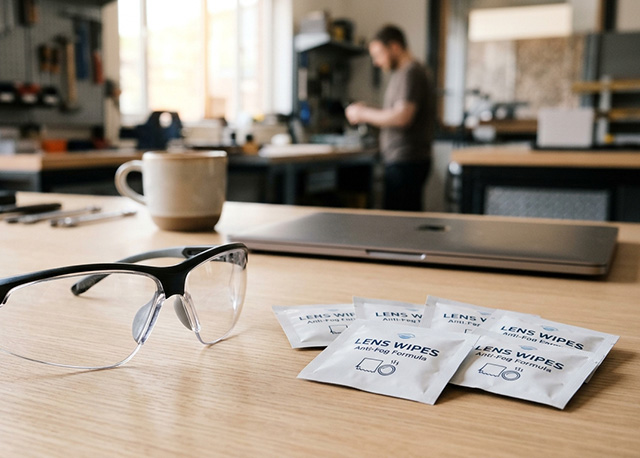
Choosing a reliable safety lens wipes manufacturer is important for brands, PPE distributors, and industrial suppliers looking to develop effective lens-cleaning products. Safety glasses and protective goggles are regularly exposed to dust, fingerprints, oil, and other contaminants. The right cleaning wipes should remove everyday residue while remaining compatible with the intended lens materials and coatings.
However, selecting a supplier involves more than comparing product prices. Buyers need to evaluate cleaning formulas, substrate materials, packaging quality, manufacturing consistency, and customization capabilities. For businesses developing anti-fog wipes for glasses, these considerations are particularly important because cleaning performance and anti-fog functionality require different product specifications.
Check Lens Compatibility and Cleaning Performance
The first consideration when sourcing safety lens wipes is whether the product is suitable for the intended eyewear.
Safety glasses, protective goggles, and prescription safety eyewear may feature different lens materials and surface coatings. A cleaning formula suitable for ordinary glass may not necessarily be appropriate for coated polycarbonate lenses or other protective eyewear.
Before selecting a manufacturer, buyers should consider:
Lens compatibility: Confirm that the formula is suitable for the intended lens materials and coatings.
Cleaning effectiveness: Evaluate its ability to remove fingerprints, dust, skin oils, and everyday smudges.
Residue control: Check whether the wipe leaves visible streaks or unwanted residue after use.
Material softness: Ensure that the substrate is suitable for delicate optical surfaces.
Product consistency: Confirm that cleaning performance remains consistent across production batches.
For businesses developing a broader eyewear-care range, understanding how to clean eyeglass lenses without scratching also helps establish appropriate product specifications.
Evaluate the Cleaning Formula
The formula directly affects how safety lens wipes perform under different working conditions.
Depending on the intended application, manufacturers may develop different formulations for general lens cleaning, anti-static performance, or anti-fog functionality.
These functions should not be treated as interchangeable.
General cleaning formulas are designed to remove fingerprints, oil, and everyday dirt.
Anti-fog formulas are developed to help reduce condensation on compatible lens surfaces.
Anti-static formulas are intended to reduce static-related dust attraction.
For industrial and occupational applications, buyers should discuss the target eyewear, expected working environment, and required product performance with the manufacturer.
It is also important to request supporting test information before using claims such as streak-free cleaning, anti-fog protection duration, or coating compatibility in commercial packaging.
A suitable formulation should be developed around the intended application rather than relying on a generic cleaning solution for every type of eyewear.
Choose Suitable Wipe Materials
The substrate is another important factor influencing cleaning performance.
Safety lens wipes should have a suitable combination of softness, absorbency, strength, and liquid distribution. A poorly selected material may leave lint, distribute the cleaning solution unevenly, or provide an inconsistent wiping experience.
Common considerations include:
Wood pulp-based substrates: These are commonly used in individually wrapped lens-cleaning wipes because of their absorbency and suitability for disposable applications.
Nonwoven substrates: Depending on their fiber composition and manufacturing process, nonwoven materials can offer different levels of softness, strength, and liquid retention.
The right material depends on the formula, lens compatibility requirements, and intended product positioning.
Buyers should evaluate material specifications and actual product samples before confirming a large production order. They can also review available wipe materials and packaging options when developing a customized product.
Compare Packaging and Customization Options
Packaging affects product convenience, moisture retention, transportation, and retail presentation.
For safety lens wipes, individually wrapped sachets are a practical option because each wipe remains sealed until use. This format is particularly suitable for workplace distribution, industrial supply channels, optical retailers, and travel-related products.
Depending on the target market, buyers may consider:
Individually wrapped sachets for single-use applications.
Multi-piece packs for retail distribution.
Customized boxes for branded product lines.
Bulk packaging for industrial and commercial customers.
Private label customization may also include brand logos, printed sachets, product labels, sheet dimensions, and packaging artwork.
When comparing manufacturers, ask whether they can support both product development and packaging customization rather than relying on standard packaging formats alone.
Assess Manufacturing Capabilities and Quality Control
A reliable safety lens wipes manufacturer should have established production procedures and quality-control checkpoints.
Consistent manufacturing is particularly important for products that require controlled liquid loading, reliable sachet sealing, and stable product specifications.
Before choosing a supplier, buyers should evaluate several areas:
Production equipment: Check whether the factory has suitable automated production and packaging equipment for the required product format.
Raw material inspection: Ask how incoming substrates, packaging materials, and formula ingredients are inspected.
Production consistency: Confirm how the manufacturer monitors wipe dimensions, liquid content, sealing quality, and packaging integrity.
Finished-product inspection: Ask about batch inspection procedures, product specifications, and available quality documentation.
Manufacturing experience: Evaluate the supplier’s experience with customized wet wipes and international B2B orders.
Certifications and test reports should also be reviewed according to the actual product category and destination-market requirements. A certification should never be assumed to cover every product performance claim.
Understand OEM and Private Label Services
For brands, distributors, and wholesalers, working with an OEM manufacturer offers greater flexibility than purchasing generic finished products.
A capable supplier should be able to discuss customization requirements before production begins.
Typical OEM and private label services may include:
Customized cleaning formulas.
Different wipe sizes and substrate materials.
Individual sachets and multi-piece packaging.
Private label branding and printed packaging.
Sample development and product evaluation.
Bulk production and export arrangements.
The development process should begin with a clear product brief covering the target market, intended eyewear, formula requirements, packaging preferences, and estimated order quantity.
This helps the manufacturer determine whether the proposed specifications are technically and commercially feasible.
For businesses planning customized lens-care products, OEM/ODM wet wipe manufacturing services provide a starting point for discussing product development and manufacturing requirements.
Compare Pricing, MOQ, and Delivery Lead Times
Price is an important purchasing factor, but the lowest quotation does not always represent the best overall value.
When comparing safety lens wipes manufacturers, buyers should request quotations based on consistent specifications.
Important details include:
Wipe dimensions and substrate weight.
Formula and liquid loading requirements.
Number of wipes per pack.
Sachet and outer packaging specifications.
Minimum order quantity (MOQ).
Sample development costs.
Production lead time.
Shipping terms and destination.
A clear quotation makes it easier to compare suppliers and identify potential additional costs before placing an order.
Buyers should also confirm whether the manufacturer can accommodate repeat orders and maintain consistent specifications as their business grows.
Request Samples Before Confirming Production
Product samples allow buyers to evaluate actual performance rather than relying entirely on descriptions or marketing claims.
Before approving a manufacturer, request samples and assess:
Cleaning effectiveness on the intended lens surfaces.
Visible streaks or residue after application.
Substrate softness and lint performance.
Sachet sealing and packaging condition.
Compatibility with the target eyewear.
Consistency between different samples.
For anti-fog or anti-static products, additional testing should be conducted under the intended application conditions.
Once the samples and specifications are approved, the buyer and manufacturer should confirm the final formula, material, packaging artwork, quality requirements, and production details.
Why Work with SYWIPE for Customized Lens Cleaning Wipes?
SYWIPE is a wet wipes manufacturer in China providing OEM and ODM manufacturing solutions for brands, retailers, wholesalers, and distributors.
With experience in customized wet wipe production, SYWIPE supports businesses developing lens cleaning wipes and other specialty cleaning products.
Our customization capabilities include:
Customized wipe dimensions and substrate options.
Formula development based on product requirements.
Individually wrapped sachets and other packaging formats.
Private label branding and packaging customization.
Sample evaluation and bulk manufacturing.
For businesses developing safety lens wipes, the first step is to define the intended eyewear, cleaning requirements, target market, and preferred packaging format.
Contact SYWIPE to discuss your product specifications and request samples for evaluation.
Frequently Asked Questions
What should I look for in a safety lens wipes manufacturer?
Look for experience in lens-cleaning wipe production, suitable substrate materials, formula customization, packaging capabilities, consistent quality control, and the ability to provide product samples.
Are anti-fog wipes the same as regular lens cleaning wipes?
No. Regular lens cleaning wipes primarily remove dirt, fingerprints, and oil. Anti-fog wipes contain specialized formulations intended to reduce condensation. Their functions and performance requirements are different.
Can safety lens wipes be used on all protective eyewear?
No. Compatibility depends on the lens material, surface coating, and cleaning formula. Always verify product specifications and follow the eyewear manufacturer’s cleaning instructions.
Can manufacturers produce private label safety lens wipes?
Yes. Depending on their manufacturing capabilities, OEM suppliers can customize formulas, wipe dimensions, packaging formats, and branding for private label products.
What packaging is suitable for industrial lens cleaning wipes?
Individually wrapped sachets are a practical option for single-use distribution in workplaces, industrial facilities, and commercial supply channels. Multi-piece packs and customized boxes may also suit retail and wholesale requirements.
Should buyers test samples before placing a bulk order?
Yes. Sample evaluation helps verify cleaning performance, lens compatibility, substrate quality, liquid content, and packaging integrity before mass production.